Bone regeneration · International patients · Barcelona
When bone is missing, start with a clearer plan.
Considering bone reconstruction for dental implants in Barcelona? Discuss your records with both doctors by video, understand the shape of the defect and plan surgery, healing and follow-up before you travel.
Complex bone and soft tissue reconstruction is a core clinical focus of OsteoPerio. Assessment determines whether grafting is appropriate and what can realistically be achieved.
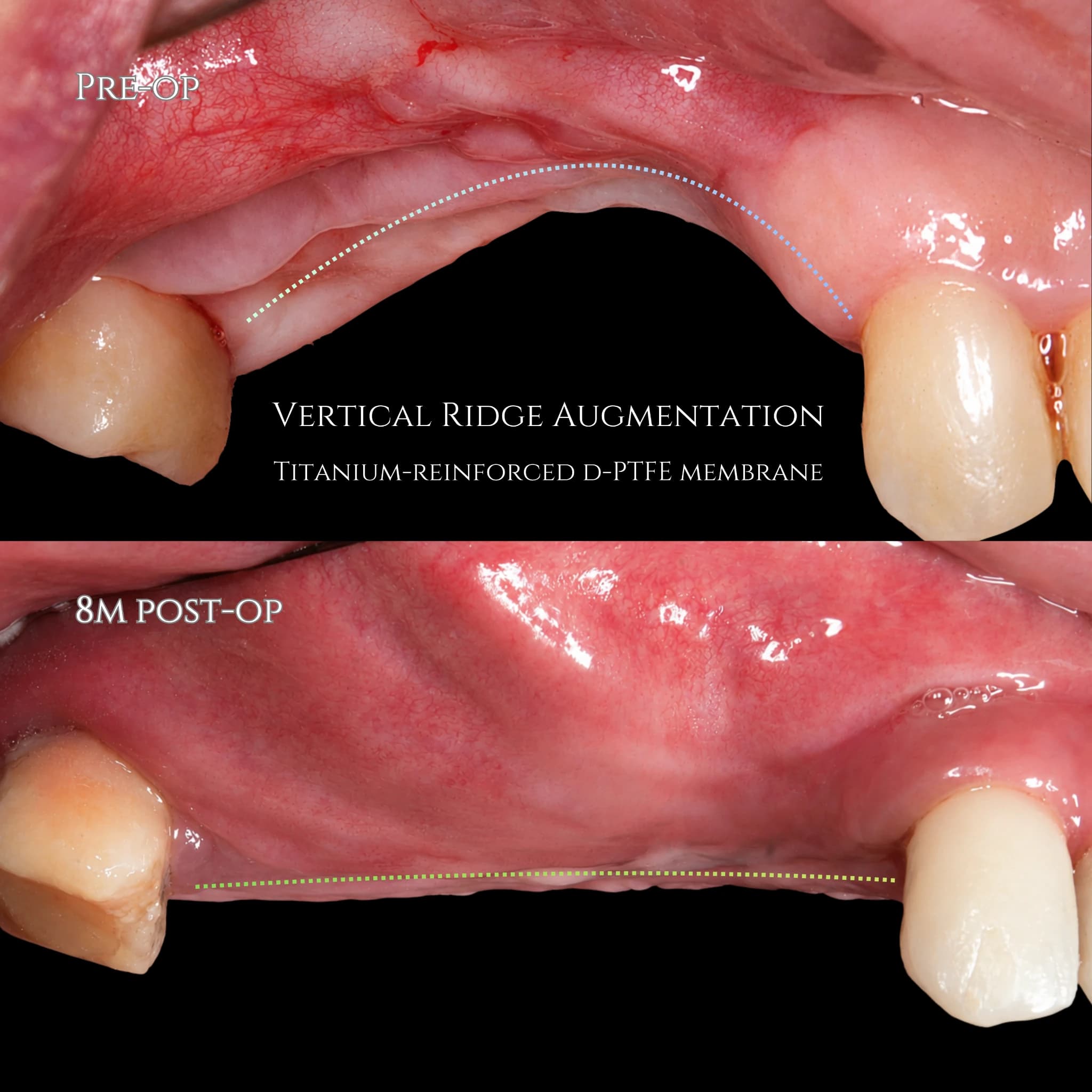
An OsteoPerio vertical-reconstruction case
Before treatment and at eight months: these photographs show the gum-covered ridge contour. They do not directly show regenerated bone or measure bone gain. The interval is specific to this case, not a treatment or travel timetable.
The ridge is the part of the jaw that supports teeth and implants. Its width, height and shape matter in relation to the proposed tooth. Examination and appropriate imaging reveal details that a photograph of the gum cannot show.
Remaining boneMissing volume, shown schematically
01 / Horizontal defect
Not enough width
The ridge is too narrow from the cheek side to the tongue or palate side. Reconstruction may be needed alongside the remaining bone.
02 / Vertical defect
Not enough height
The top of the ridge has receded. The aim is to build bone above the remaining ridge, where the graft has less natural support.
03 / Combined defect
Height and width are missing
The ridge is both lower and narrower. The shape of the defect and the available gum tissue need to be considered together.
Original educational cross-sections, shown upright and not to scale. The dashed outline is a comparison reference, not a promised regeneration target. Gum tissue, nerves and the sinus are omitted; real defects are three-dimensional and may be uneven.
The remaining walls also matter.
A defect surrounded by bone has different support from an area that must be built outwards or upwards. Previous infection, scarring and the condition of the gum also influence the approach. Width or height alone does not determine the operation.
A sinus lift addresses a different space.
At the back of the upper jaw, limited height may relate to the sinus above the ridge. A sinus lift creates space beneath its lining; vertical ridge regeneration rebuilds the ridge itself. Some sites have more than one problem.
In guided bone regeneration (GBR), graft material supports a space where new bone can develop. A barrier membrane helps separate that space from the overlying soft tissue. This is different from a surgical guide used to position an implant.
Stability and support
The graft and membrane need to remain stable. Larger or less contained defects may need additional support or fixation.
Careful gum closure
The gum must cover the reconstruction without excessive tension. Thin or scarred tissue can make this more demanding; wound opening may expose the graft or membrane.
Biological healing
Blood supply, infection control, general health, smoking and maintenance affect healing. Added graft material is not an instant replacement for mature bone.
Inside a protected grafted site
1.Gum tissue
2.Barrier membrane
3.Graft material
4.Remaining bone
Original educational cross-section, not to scale. It shows one general principle, not a surgical instruction or predicted result. Fixation, blood vessels, nerves and the sinus are omitted. The grafted space is not yet mature bone.
Two possible treatment sequences
The bone condition helps determine the sequence.
A key question is whether an implant can be positioned correctly and held stable in the remaining bone. The defect and soft tissue must also allow the proposed reconstruction.
For selected sites
Grafting with implant placement
May be considered when the existing bone can stabilise an implant in the planned position and the surrounding defect can be managed at the same operation.
1Graft + implant placement
2Healing and clinical review
3Restoration when ready
When rebuilding comes first
Grafting before implant placement
A separate grafting stage may be needed when the defect is extensive or there is insufficient support for an implant in the intended position. Reassessment can change the plan.
1Reconstruction + healing
2Reassessment → implant placement if ready
3Implant healing → restoration
These are simplified pathways, not a count of appointments. Disease control, soft tissue surgery, temporary teeth or membrane removal may add stages.
Your first stay covers assessment, treatment and initial review. It should not be confused with the time needed for bone maturation or completion of the final teeth.
After receiving the full documentation, Dr. Sahand Shirzadi Maryan and Dr. Sergi Rivas Frau meet you in a scheduled video consultation. They explain the diagnosis based on those records, proposed reconstruction, alternatives and likely treatment stages. An examination in Barcelona confirms the findings before treatment.
02
Surgery and initial healing
Plan time for care in Barcelona.
Your visit needs to allow for assessment, the agreed surgery and review through the initial healing phase. The length of stay depends on the procedure and your recovery. Wound closure at an early review does not mean the graft is ready for an implant.
03
Between treatment stages
Let healing guide the next visit.
After our initial healing review, follow-up can continue with your local dentist as agreed. Graft maturation takes months rather than days. Later assessment determines whether the site is ready for an implant; any membrane or fixation removal also needs to be planned.
04
Implants, teeth and maintenance
Coordinate the complete treatment.
Implant placement, healing and the final crown or bridge may involve further appointments or trips. Agree who provides temporary teeth, the final restoration and ongoing maintenance. Travel dates remain provisional until the clinical team confirms the next stage.
A balanced decision
Discuss the limits as well as the possibilities.
Swelling, soreness and bruising can follow grafting. Infection, wound opening, membrane exposure, graft loss or insufficient bone gain may require additional care or a change of plan. Bleeding, donor-site problems and injury to nearby nerves or the sinus depend on the procedure and anatomy.
Ask about alternatives, temporary teeth and the practical consequences if healing takes longer. Your own risk assessment matters more than a general success percentage.
General patient information on grafting, materials and risks. This source does not assess the pictured case or define your individual treatment timetable. Illustrations on this page are original educational diagrams.
No. The existing bone must be assessed in relation to the intended implant and tooth. Selected patients may have a different implant option, a bridge, a removable replacement or choose not to replace the tooth. Further grafting is not automatically the right choice after a previous implant failure.
How much bone can you rebuild?
There is no single amount that applies to every site. The defect shape, remaining bone walls, blood supply, gum tissue, nearby anatomy and healing affect what is realistic. Your plan should explain the intended gain and limitations; the diagrams do not show a guaranteed target.
Do I need a new CBCT scan before contacting you?
Start with the records you already have and their dates. Three-dimensional imaging may be needed to assess the defect and nearby nerves or sinus. The team will explain what is suitable and whether additional imaging is clinically indicated. Do not arrange a new scan solely to make an enquiry.
Where do the graft and membrane come from?
Bone grafts can use your own bone or human-donor, animal-derived or synthetic materials, sometimes in combination. Membranes also differ in origin and whether they dissolve or need removal. The proposed materials, any donor site and suitable alternatives should be discussed before you consent; tell us about personal or religious preferences early.
How long should I stay in Barcelona?
Stay through the initial healing phase and our team’s review, as appropriate for your operation. Agree an individual estimate before travel and allow flexibility if healing needs more attention. This stay is different from the longer period needed for bone development; a photograph taken at eight months is not a travel recommendation.
Will the membrane need to be removed?
Some membranes break down over time; others require a later procedure. Fixation devices may also need removal. Whether this is combined with another treatment stage depends on the technique and healing. Include this in the visit plan and estimate before treatment.
What if a problem develops after I return home?
Agree follow-up responsibilities and contact arrangements before leaving Barcelona. Contact the treating team for concerns; seek prompt local assessment for increasing pain, swelling, bleeding or wound opening rather than waiting for a remote reply. A complication may require additional treatment or a return visit.
What should my estimate cover?
Clarify assessment and imaging, graft materials, any donor-site procedure, membrane or fixation removal, implant placement, temporary and final teeth, and follow-up. Ask which stages are included or separate, and allow for accommodation and possible additional travel.
Your next step
Understand what rebuilding could involve for you.
Request an international video consultation and select “Bone regeneration before implants” as your main concern. Tell us what you have been advised, any previous grafting or implant treatment, the records available and where you live.
Appointments take place at collaborating dental clinics in Barcelona. The clinical location is confirmed when your visit is arranged. Private surgery is provided by Sahand and/or Sergi according to your plan. The supervised programme remains in preparation and is not yet bookable.