Rebuilding lost bone height. Planning beyond implant loss.
After implant loss associated with advanced peri-implantitis, the back of the upper jaw had lost substantial bone height. This case shows a staged approach to rebuilding the ridge before further implant care—a type of complex reconstruction at the centre of OsteoPerio’s clinical focus.
One patient’s treatment sequence. Suitability and healing vary; your own options require an assessment.
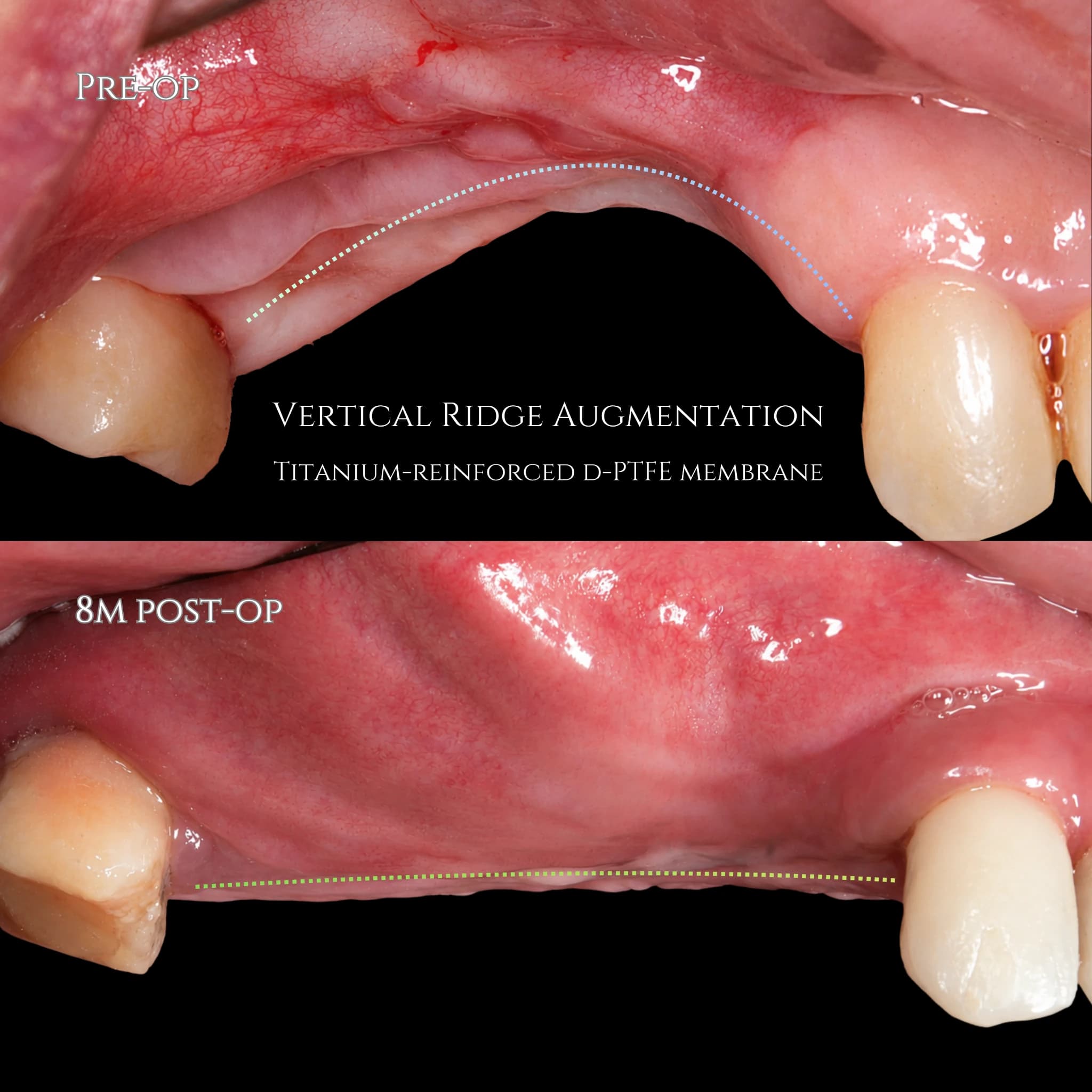
Before regeneration / 8 months after surgery
The original comparison shows the surface contour of the ridge before treatment and at eight months. The dotted lines highlight that change. Clinical assessment and imaging are needed to evaluate the bone beneath the gum.
An implant needs a foundation. Here, that foundation needed rebuilding.
The clinical concern
An implant had been lost after advanced peri-implantitis, a disease affecting the tissues and bone around implants. The remaining ridge at the back of the upper jaw had lost substantial height, leaving too little bone for the planned implant replacement.
What informed the plan
The plan considered the shape of the remaining bone, where future implants would need to sit, and how the graft could be supported. The gum also needed to cover the rebuilt area without excessive tension and protect it during healing.
Why regenerate before an implant?
Plan the tooth. Build the support it needs.
An implant replaces a tooth root. Its position needs to work for the future tooth and the surrounding tissues. When ridge height is missing, part of the planned implant body may lack bone coverage. These diagrams explain why a staged reconstruction may be considered.
Remaining boneGraft before maturationIllustrated bone after healingSupported barrierGum tissue
01 / The planning problem
The planned implant needs more bone.
The dashed implant shows a hypothetical position for the future tooth. In this example, part of the implant body would sit outside the existing bone. Placing the implant alone would not rebuild the missing ridge.
Why this matters
The intended tooth helps guide implant position. The surgeon assesses bone coverage, initial stability and nearby anatomy together; a gap cannot be judged by a percentage alone.
02 / Reconstruction and healing
Build and protect the missing volume.
In a staged approach, graft material is supported beneath a barrier, then covered by the gum. The illustration shows the grafted space before it has matured; no implant is placed in this panel.
Why we wait
The graft needs protected healing and biological bone development. The site is reassessed before deciding whether there is suitable support for an implant.
03 / Implant placement if suitable
Place the implant in the assessed foundation.
This simplified planning goal shows the implant body surrounded by bone after reconstruction. Actual placement depends on the bone achieved, its quality and the clinical findings—not on the drawing.
What comes afterwards
Implant healing and the final tooth are further stages. The dashed tooth remains a planning reference, not a statement that a crown has already been fitted.
Original educational cross-sections of one possible staged approach, not to scale and not a reconstruction of this patient’s scans. No percentage of exposed implant or measured bone gain is implied. “Outside the bone” does not necessarily mean visible in the mouth: gum may cover the area. The sinus, nerves, blood vessels and fixation details are omitted. The implant-tooth outline and healed contour are planning examples, not promised results.
How this relates to the case
Reconstruction first. New implants subsequently placed.
In this case, ridge height was rebuilt using a titanium-reinforced barrier and a graft of 60% animal-derived substitute with 40% of the patient’s own bone. The treating team has confirmed that new implants have been placed. The exact placement interval and final restoration are not shown by these illustrations.
What the photograph tells us
The available photograph shows the gum-covered ridge before treatment and at eight months. It does not show implant placement or measure bone coverage. Re-entry and implant-placement photographs can be added separately when available.
Some sites allow grafting and implant placement together; others need a different implant or tooth-replacement option. The aim is appropriate support for the planned restoration, with risks and alternatives assessed individually.
Understanding the reconstruction
The same missing tooth. Very different bone conditions.
The ridge is the part of the jaw that supports teeth and implants. A space where a tooth is missing tells us little about the bone underneath. Examination and appropriate three-dimensional imaging help establish what is missing and what can realistically be rebuilt.
Remaining boneMissing volume, shown schematically
01 / Horizontal defect
Not enough width
The ridge is too narrow from the cheek side to the tongue or palate side. Reconstruction may be needed alongside the remaining bone.
02 / Vertical defectThis case
Not enough height
The top of the ridge has receded. The aim is to build bone above the remaining ridge, where the graft has less natural support.
03 / Combined defect
Height and width are missing
The ridge is both lower and narrower. The shape of the defect and the available gum tissue need to be considered together.
Original educational illustrations. Simplified cross-sections shown upright for comparison, not to scale. The outline is a visual reference, not a promised regeneration target; gum tissue, nerves and the sinus are omitted. Actual defects are three-dimensional and may be uneven.
A local opening is another pattern.
Sometimes bone is missing only over part of a root or implant. An opening that reaches the ridge edge is called a dehiscence; a window with bone still above it is a fenestration. These differ from rebuilding the height of an entire ridge segment.
A sinus lift addresses a different space.
At the back of the upper jaw, the sinus may limit the available bone height. A sinus lift creates space beneath its lining. Vertical ridge regeneration rebuilds the ridge itself. Assessment determines whether one problem, or a combination, needs attention.
Complex reconstruction. Carefully planned, step by step.
Advanced bone and soft tissue reconstruction is central to OsteoPerio’s clinical focus. Dr. Sergi Rivas Frau and Dr. Sahand Shirzadi Maryan assess complex defects, previous implant loss and the conditions needed for further treatment. The first decision is whether reconstruction is appropriate for you.
01
Create space where bone is missing
Building above the remaining ridge gives the graft less natural containment. The shape of the defect and its remaining walls affect how that space can be supported.
02
Keep the graft stable and protected
A supported barrier can help maintain the planned space and separate it from the overlying soft tissue during healing. Graft movement or loss of protection can compromise the reconstruction.
03
Close the gum without excessive tension
The gum has to cover a larger volume. Its thickness, mobility and previous scarring influence the surgical design; opening of the wound can expose the membrane or graft.
04
Allow healing, then reassess
Bone development takes time. Control of disease, smoking, general health and maintenance all matter. The next operation depends on healing and the bone achieved, rather than the calendar alone.
What needs an individual discussion?
The proposed bone gain, graft source, membrane, donor site, temporary teeth, visits and costs. Swelling and discomfort are expected after surgery; infection, wound opening, graft exposure or insufficient bone gain may require additional care or a change of plan. Risks also depend on nearby anatomy.
Reconstruction is one possible route.
Selected patients may have alternatives such as a different implant plan, a bridge or a removable replacement. The remaining bone, bite, neighbouring teeth and your priorities determine the options. A previous implant failure does not automatically mean another graft is the right choice.
Each stage has a different purpose. The sequence below places the photographs in the wider course of assessment, treatment and follow-up.
01
Assessment after implant loss
Understand the defect and the previous disease
The case history describes implant loss following advanced peri-implantitis—an inflammatory condition involving loss of supporting bone around an implant. The remaining ridge in the back of the upper jaw lacked sufficient height for the planned new implant treatment.
02
Reconstruction planning
Design the space for bone regeneration
Planning considered the defect shape, the intended implant reconstruction, support for the graft and the gum tissue needed for closure. The aim was to rebuild the ridge before reassessing it for new implants.
03
Regenerative surgery
Support the graft beneath a reinforced barrier
The technique used a titanium-reinforced dense PTFE membrane: a non-dissolving barrier with a supporting framework. The graft combined 60% xenograft, an animal-derived bone substitute, with 40% of the patient’s own bone. These were the materials selected for this case, not a fixed recipe for every defect.
04
Closure and protected healing
Cover the reconstruction and allow it to mature
The gum was closed over the reconstructed area without excessive tension. Stable coverage and graft protection were key parts of the plan while healing progressed. The reinforced membrane would require a planned removal procedure rather than dissolving on its own.
05
8-month re-entry
Assess the regenerated foundation
The case record describes re-entry at eight months to assess the regenerated foundation. The photograph shown here is a surface view at that interval, rather than a view of the exposed bone at re-entry.
06
Subsequent implant care
Place implants in the reconstructed area
The treating team confirms that new implants have been placed. Photographs of re-entry and implant placement have not yet been added to this page. Their exact timing and the final restoration are not represented by the eight-month surface photograph.
Reading the follow-up
An eight-month review of a rebuilt ridge.
What the image shows
The lower photograph shows a fuller ridge contour at eight months compared with the preoperative view. The original annotations help show the change in the visible soft tissue profile.
What it cannot establish
Surface photographs do not measure bone height, width or quality. The reported bone gain comes from the case’s re-entry history, not a measurement from these pictures. The implants have since been placed, but their placement, final crowns and long-term outcome are not shown here.
The eight-month interval belongs to this patient’s treatment. Implant placement has been confirmed by the treating team; the associated surgical photographs can be added to the record separately. Another patient may need a different sequence, further grafting or an alternative plan.
Your questions
Putting this case in context.
Why rebuild the bone before placing another implant?
This ridge had lost height after the previous implant was lost. The planned reconstruction aimed to create a more suitable foundation for future implants. Placing another implant alone would not replace the missing ridge volume.
Is vertical regeneration the same as a routine bone graft?
Bone grafts address different defect shapes. Vertical regeneration aims to build above the remaining ridge and requires careful support of the graft, protection of the space and gum closure. The size of the defect, remaining walls, tissue condition and health factors all affect complexity.
What does the reinforced membrane do?
It helps support and protect the space containing the graft while healing takes place. In this case, the dense PTFE barrier was reinforced with titanium. It is non-dissolving, so removal must be planned as part of care.
Will everyone be ready for implants after eight months?
No. Eight months is the re-entry interval documented for this case. Implant timing depends on the procedure, healing and the bone present at reassessment. Final tooth restoration is a later part of the overall plan.
Can I avoid a major grafting procedure?
Sometimes a different implant design or position, a bridge or a removable replacement may be considered. Suitability depends on your remaining bone, nearby anatomy, bite and treatment goals. An assessment should compare the realistic options before you commit to surgery.
Can OsteoPerio review previous implant or graft failure?
Yes. Complex bone and soft tissue reconstruction is a core focus of the team. Share your concerns and tell us which previous records are available. Assessment considers the cause of the earlier problem, disease control, current anatomy and whether further reconstruction is appropriate.
Discuss previous implant loss, a proposed graft or an alternative plan.
Start with an assessment.
Tell us what concerns you. In the enquiry form, choose “Bone regeneration before implants” as your main concern. The team can explain the next step and which existing records may be useful.
Appointments take place at collaborating dental clinics in Barcelona. The clinical location is confirmed when your visit is arranged. For visits from abroad, agree the assessment arrangements before booking travel.
Individual results vary. Vertical GBR is biologically demanding and depends on defect anatomy, soft tissue closure, graft stability, healing response and maintenance control.