The clinical concern
A previously root-treated tooth developed an abscess and a persistent draining fistula, with pain and difficulty chewing. The existing case history records that the tooth could not be saved and was extracted.
Clinical case · Bone Regeneration
An infected, previously root-treated tooth caused pain and difficulty chewing. Care began with extraction and healing, followed by implant placement with bone grafting in the same operation. The photographs bring the starting point and later restored appearance together.
Surgery performed by Dr. Sahand Shirzadi Maryan and Dr. Sergi Rivas Frau.
One patient’s treatment sequence. Suitability and healing vary; your own options require an assessment.
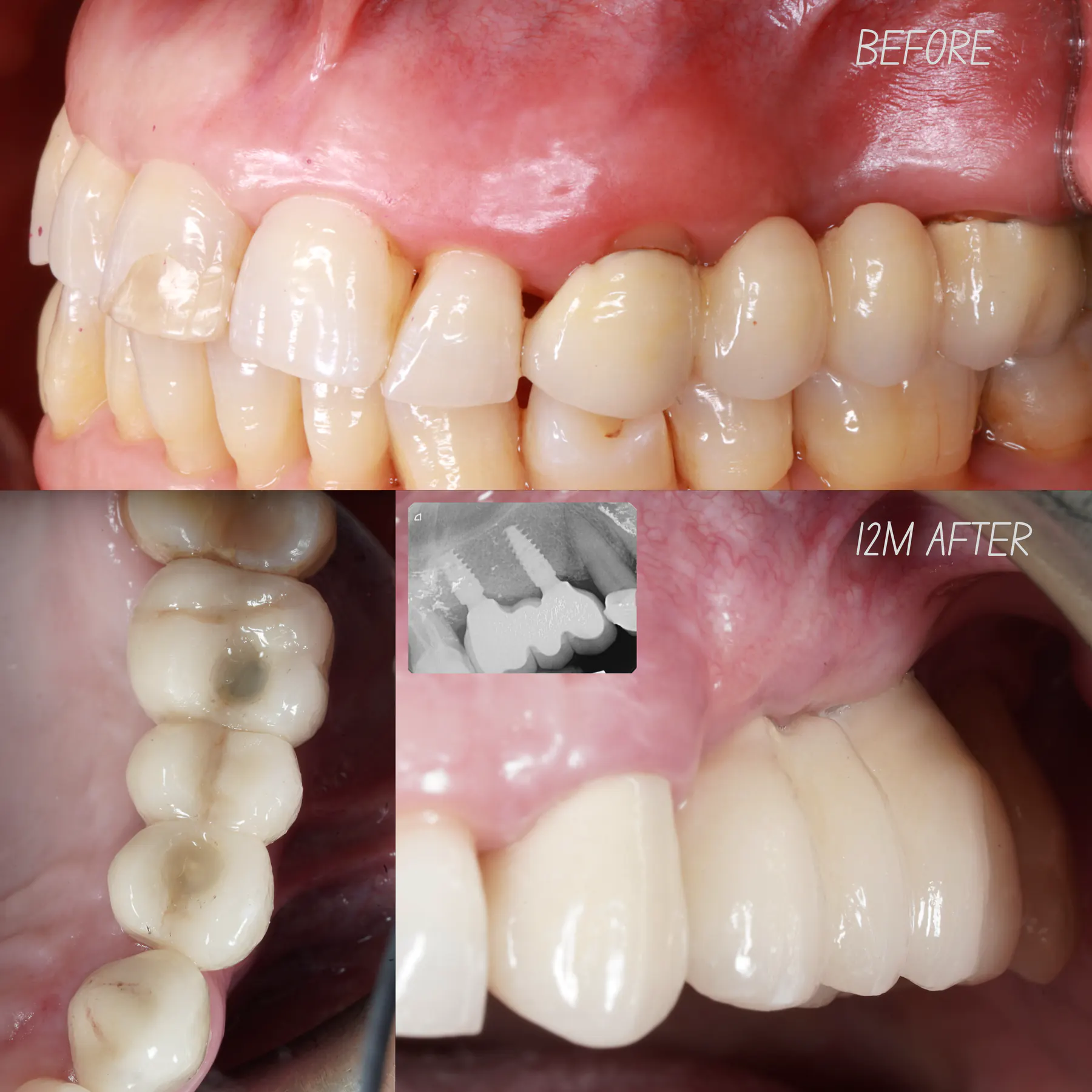
Before treatment / 12-month follow-up
The upper photograph shows the starting point. The lower panel brings together restored tooth and gum views with an implant radiograph at the confirmed 12-month follow-up. The original time labels remain visible.
View full-size image (opens in a new tab)The starting point
A previously root-treated tooth developed an abscess and a persistent draining fistula, with pain and difficulty chewing. The existing case history records that the tooth could not be saved and was extracted.
The plan separated removal of the infected tooth from implant surgery. After a healing interval, the site was reassessed before implant placement with bone grafting during the same operation.
Why separate the stages?
Removing the infected tooth addressed the starting problem. Preparing a suitable implant foundation was a later task. These illustrations explain why waiting, reassessing and rebuilding each had a role in this case.
This previously root-treated tooth had an abscess and a draining channel in the gum. The case record describes pain, difficulty chewing and a decision that the tooth could not be saved.
Why this matters
Extraction was the treatment chosen here. An infection around a root-treated tooth does not automatically mean extraction; the remaining tooth and other treatment options need assessment.
The tooth was removed first. After four to five months of healing in this case, the site was reassessed for reconstruction. Gum healing does not necessarily restore the width of the underlying ridge.
Why this matters
The dashed implant shows a planning example: part of its intended position lacks bone coverage. We assess the remaining bone, planned tooth position and potential implant stability together.
At the later operation, implant placement and bone grafting were performed together. The recorded graft combined the patient’s own bone with additional graft material.
Why this matters
The implant needs initial stability in the available bone. The grafted region then needs protected healing and bone development; freshly placed graft is not yet mature supporting bone.
Restorative care follows assessment of the implant and surrounding tissues. The supplied case composite includes restored clinical views and an implant radiograph at a confirmed twelve-month follow-up.
Why this matters
The illustration shows the treatment goal, not a measurement of this patient’s regenerated bone. The photographs and radiograph are part of the follow-up record, alongside the clinical examination.
Educational upper-jaw cross-sections, not to scale or reconstructions of this patient’s scans. The lesion, width defect and rebuilt contour are schematic; no percentage of exposed implant or measured bone gain is implied. Outside the bone does not necessarily mean visible in the mouth. Neighbouring teeth, full anatomy and graft-protection details are omitted. One implant is used to explain the principle, not to reproduce the number or arrangement in the clinical photographs.
Different stages, different purposes
The four-to-five-month interval belongs to this patient’s extraction-to-reconstruction history. It is not a universal waiting period. Graft healing and implant integration still follow the later operation before restorative decisions.
The treating team confirmed the twelve-month review shown in the original composite. That label should not be read as the total treatment duration or as a measured amount of new bone. The available record does not specify the event from which that interval was counted.
Follow this patient’s treatment stagesTreatment sequence
Each stage has a different purpose. The sequence below places the photographs in the wider course of assessment, treatment and follow-up.
The starting point
The original history describes an abscess and a persistent fistula — a channel through which infection can drain — around a tooth that had received root canal treatment. Pain and difficulty chewing prompted assessment.
Extraction
The treatment decision recorded for this patient was extraction. This describes the decision in this case; it does not mean every infection around a root-treated tooth requires removal.
4–5 months in this case
The site was allowed to heal after extraction before the next operation. The original history records an interval of four to five months and resolution of the infection before proceeding. This is the reported sequence for this patient, rather than a timetable for other cases.
Reconstructive surgery
Implant placement and bone regeneration were performed in the same operation. The patient’s own bone was supplemented with bone graft material to reconstruct the implant site, as described in the case history.
12-month follow-up
The follow-up record includes restored tooth and gum views alongside an implant radiograph. These show a later stage of care, after reconstruction and restoration, rather than an immediate result at the extraction appointment.
Reading the follow-up
The lower panel shows the restored area from two clinical viewpoints and includes a radiograph showing an implant and restoration. The treating team has confirmed the twelve-month follow-up shown in the original label.
This composite does not quantify regenerated bone or establish how the implant will perform over future years. Interpretation of bone levels and tissue health also depends on the clinical examination and comparison with earlier records.
The image and original case history are presented together so the sequence is understandable. Individual outcomes and future maintenance needs require clinical review; a photograph is one part of that record.
Your questions
No. The original case history describes extraction first, followed by four to five months of healing. Implant placement with bone grafting took place at the later operation.
In this case, they were performed together after the extraction site had healed. The overall treatment still involved separate stages: extraction, healing, reconstructive surgery and restoration.
The graft was used to reconstruct the implant site during implant placement. The case history describes the patient’s own bone together with additional graft material; the photographs do not provide a measurement of the amount of bone gained.
It identifies the twelve-month follow-up, confirmed by the treating team. It should not be read as the total treatment duration: extraction, healing, implant surgery and restoration were separate stages of care.
Explore your options
Explore how bone reconstruction fits into an implant treatment plan.
Understand the separate role of socket and ridge preservation.
Discuss a proposed extraction, bone graft or implant plan.
Tell us what concerns you. In the enquiry form, choose “Bone regeneration before implants” as your main concern. The team can explain the next step and which existing records may be useful.
Appointments take place at collaborating dental clinics in Barcelona. The clinical location is confirmed when your visit is arranged. For visits from abroad, agree the assessment arrangements before booking travel.
Individual results vary. Regenerative outcomes depend on defect anatomy, infection control, soft tissue closure, patient factors and healing response.