The clinical concern
An upper right tooth was compromised by infection and advanced loss of supporting tissue. The original history also describes inflammation and bone loss around a neighbouring implant.
Clinical case · Bone Regeneration
Infection and loss of supporting tissue affected an upper right tooth, with inflammation and bone loss also described around a neighbouring implant. Treatment involved extraction and healing, implant placement with horizontal bone grafting, and a later procedure to improve gum volume.
Surgery performed by Dr. Sahand Shirzadi Maryan and Dr. Sergi Rivas Frau.
One patient’s treatment sequence. Suitability and healing vary; your own options require an assessment.
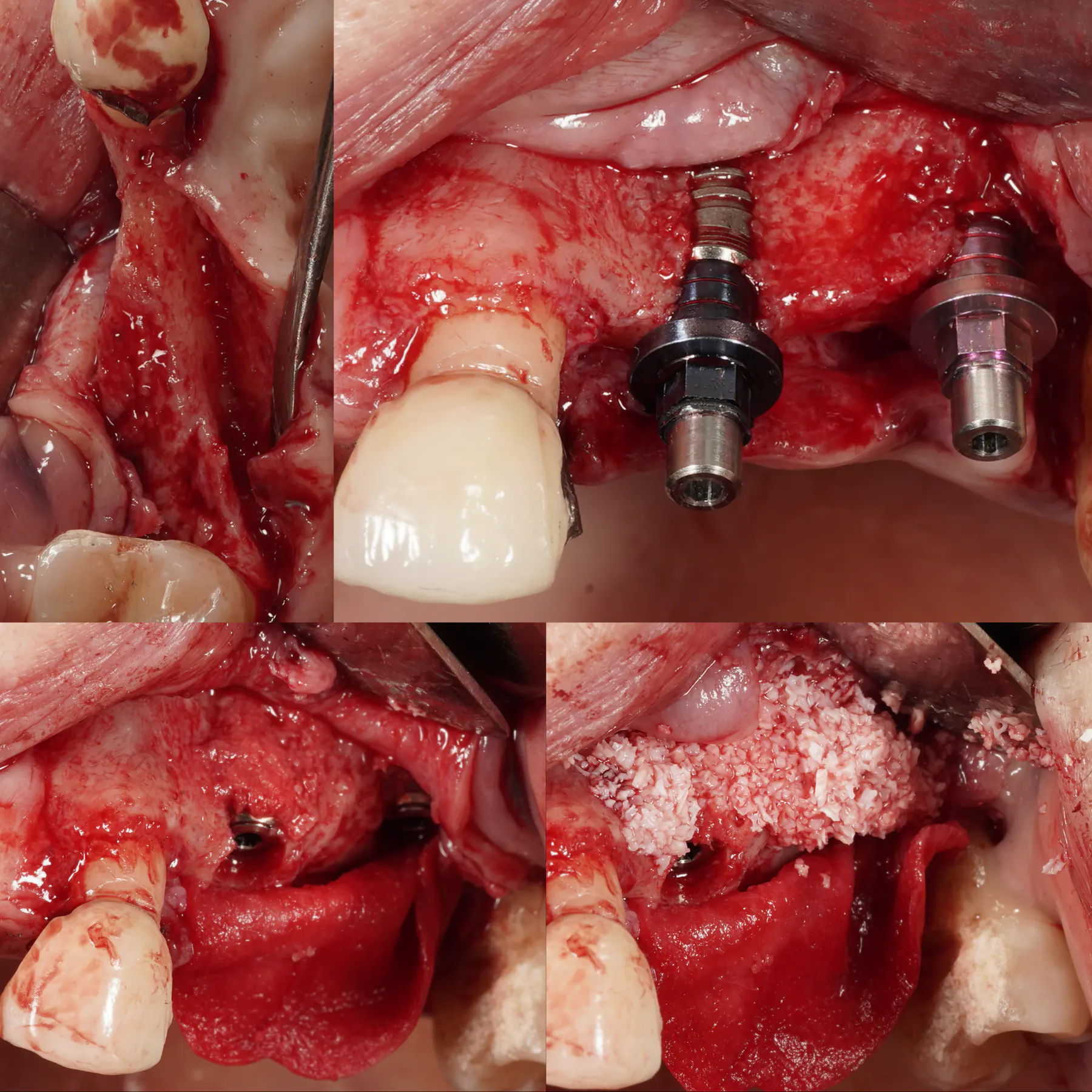
Surgical stages · bone reconstruction
This composite shows the surgical site, implants and placement of bone graft material. These are photographs taken during treatment; they do not show the healed gum contour or the final restoration.
View full-size image (opens in a new tab)The starting point
An upper right tooth was compromised by infection and advanced loss of supporting tissue. The original history also describes inflammation and bone loss around a neighbouring implant.
After extraction and healing, a three-dimensional scan showed that the outer bone wall was missing. The plan addressed ridge width during implant placement and soft tissue volume in a later procedure.
Why treat bone and gum separately?
Bone provides the implant foundation; gum covers it and helps shape the visible contour. This case needed care for both, at different stages. The illustrations explain what each procedure was intended to achieve.
After the compromised tooth was removed and the area healed, a three-dimensional scan showed loss of the outer bone wall. The ridge needed more width for the planned implant reconstruction.
Why this matters
A gum-covered ridge can still have an underlying bone defect. The dashed implant illustrates why the intended position must be assessed against the bone available, rather than judged from the gum surface alone.
Implant placement and horizontal bone grafting were performed during the same later operation. The graft addressed the missing width on the outer side of the ridge.
Why this matters
The implant needs stability in the available bone. The grafted area then needs protection and healing as bone develops. The surgical photographs show graft placement, not the amount of healed bone.
A roll flap was used later to improve the cheek-facing gum contour. In this approach, nearby soft tissue is folded beneath the gum to add volume while retaining a local attachment.
Why this matters
This step addresses the soft tissue over the foundation. Increasing gum volume has a different purpose from rebuilding the bone that supports an implant.
Educational cutaways, not to scale or reconstructions of this patient’s scans. One implant explains the principle, not the number or arrangement in the photographs. The purple fold is a simplified roll-flap concept, not an incision plan or proof of tissue gain. Graft protection, full anatomy, neighbouring implants and restoration details are omitted. The illustrations do not establish healed bone volume or the final gum contour.
One plan, separate healing stages
The implant and bone graft were placed at a later operation, followed by the roll flap in another phase. The exact intervals are not specified in the case history. Each next step depends on reassessment of the tissues, rather than a fixed schedule.
The four photographs show operative stages of bone reconstruction. They do not show the healed roll-flap result. The team has confirmed later crown rehabilitation and one-year follow-up records; those separate follow-up images have not yet been added to this page.
Follow this patient’s treatment stagesTreatment sequence
Each stage has a different purpose. The sequence below places the photographs in the wider course of assessment, treatment and follow-up.
Extraction and healing
The upper right tooth was removed after infection and advanced loss of its supporting tissues. The original history also notes inflammation and bone loss around a neighbouring implant. The area was allowed to heal before reconstruction.
Planning after healing
A three-dimensional scan showed that the outer bone wall was missing. This helped define the need to rebuild the width of the ridge as part of the implant treatment plan.
Implant and bone surgery
The case history describes implant placement with horizontal bone regeneration during the same operation. Bone graft material was used to reconstruct the lost width. The surgical composite illustrates this stage of care.
Later soft tissue procedure
A roll flap was used in a later phase to improve soft tissue volume on the cheek-facing side of the area. This addressed the gum contour as a separate part of care following the bone reconstruction described above.
Restoration and review
The treating team reports a clinical photograph one year after treatment and a radiographic review one year after crown rehabilitation. These later records belong to the follow-up phase, separate from the surgical photographs shown here.
Reading the follow-up
The composite provides direct views of the exposed ridge, implants and bone graft placement. It helps explain what bone reconstruction involved during surgery.
These operative photographs cannot establish the amount of healed bone, implant integration or the later gum contour. They also do not show the result of the roll flap or a final tooth restoration.
The treating team confirms later crown rehabilitation and a radiographic review one year afterwards, as well as a clinical photograph one year after treatment. Those reported reviews are distinct from the operative image set on this page.
Your questions
The original history describes loss of the outer bone wall as well as a need to improve soft tissue volume. Bone grafting addressed ridge width during implant placement; the later roll flap addressed the cheek-facing gum contour.
No. The history describes removal of the compromised tooth and a period of healing first. Implant placement and horizontal bone grafting were then performed together. The exact interval between these stages is not specified.
No. They show surgical stages, including implants and bone graft placement. A healed follow-up photograph and the clinical review would provide different information from these operative views.
The starting history notes inflammation and bone loss around it, but does not provide a separate account of its treatment or later outcome. The photographs alone do not establish whether it was retained, replaced or treated in another way.
Explore your options
Explore ridge reconstruction and how it fits into implant care.
Understand assessment and treatment of the surrounding soft tissue.
Discuss bone loss, an existing implant or a proposed reconstruction.
Tell us what concerns you. In the enquiry form, choose “Bone regeneration before implants” as your main concern. The team can explain the next step and which existing records may be useful.
Appointments take place at collaborating dental clinics in Barcelona. The clinical location is confirmed when your visit is arranged. For visits from abroad, agree the assessment arrangements before booking travel.
Individual results vary. Combined hard and soft tissue outcomes depend on defect anatomy, infection control, tissue closure and healing response.