Thickness & contour
Supporting the tissue profile
Connective tissue grafting may be considered for thin tissue or a contour deficiency. The assessment also considers whether recession or a grey shadow can be improved and which limitations remain.
Peri-implant soft tissue care · Barcelona
Receding or thin tissue around an implant can affect comfort, cleaning and appearance. We assess the implant, its restoration and the surrounding tissues to understand whether soft tissue reconstruction could help.
Private care with Dr. Sahand Shirzadi Maryan and/or Dr. Sergi Rivas Frau, according to your treatment plan.
Appointments take place at collaborating dental clinics in Barcelona. The clinical location is confirmed when your visit is arranged.
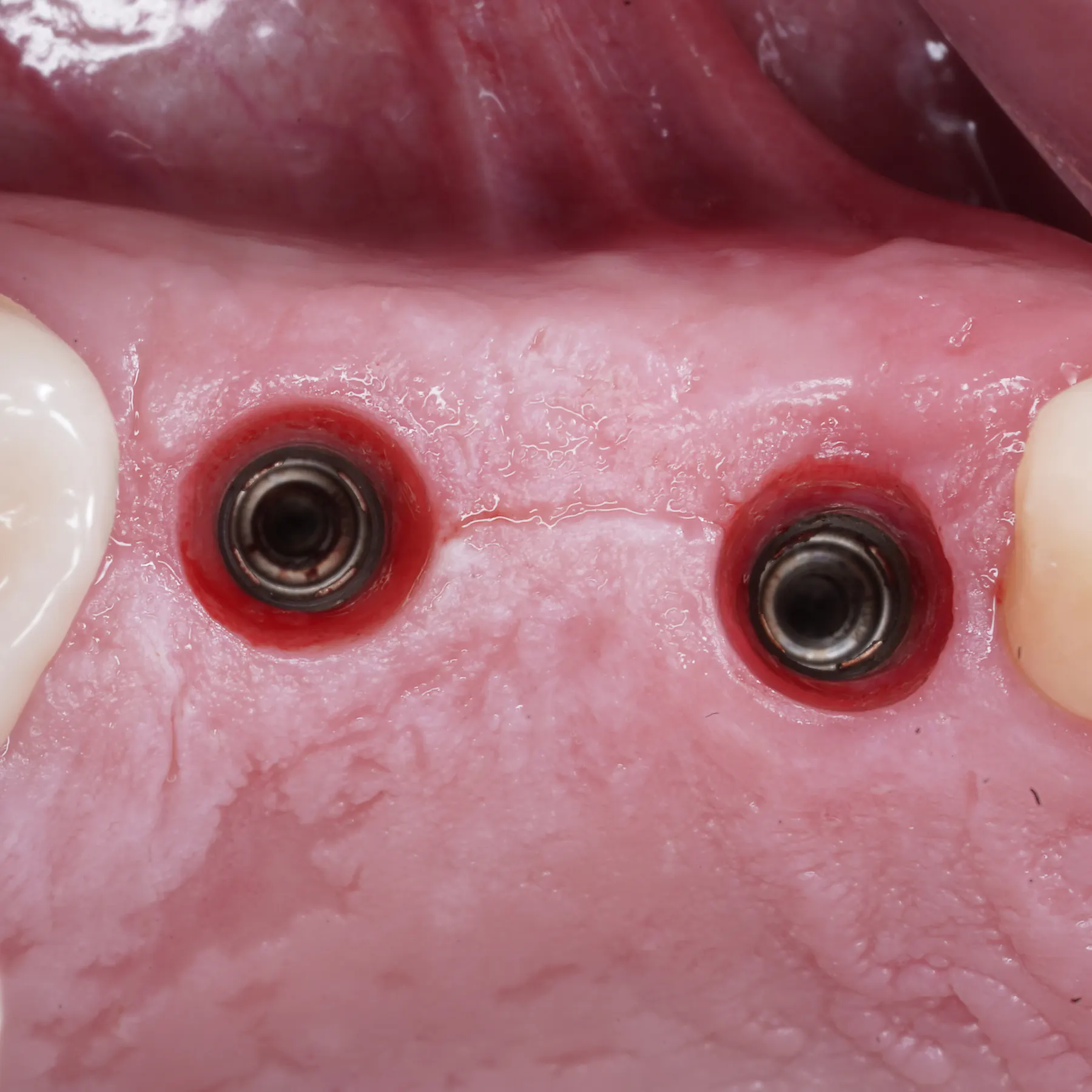
A closer view of peri-implant tissue
The photograph shows tissue around two implant connections without crowns in place. A single view cannot establish tissue health or measure the benefit of treatment. Individual outcomes vary.
Explore this implant caseDifferent concerns, different aims
Soft tissue reconstruction aims to improve the tissue around an implant. The proposed technique should match the concern: adding volume and improving coverage are different goals from increasing the band of firmer tissue.
Thickness & contour
Connective tissue grafting may be considered for thin tissue or a contour deficiency. The assessment also considers whether recession or a grey shadow can be improved and which limitations remain.
Firmer tissue & cleaning
Where the band of keratinized tissue is limited and cleaning is uncomfortable, augmentation may be considered. The aim and technique are chosen after assessing hygiene access and the surrounding tissues.
A graft is not automatically needed for every thin or receding site. Monitoring, improved cleaning and changes to the restoration may be appropriate, depending on the findings.
Understand the cause first
Bleeding, swelling or discharge need assessment for peri-implant disease. If inflammation or bone loss is present, it needs its own treatment plan; covering the area with a graft is not a substitute.
The position of the implant and its supporting bone influence tissue shape. Grafting alone may not resolve a major positioning problem, so the assessment includes whether the implant can reasonably be retained.
The shape of the restoration affects the tissue and access for cleaning. Adjustment, a temporary restoration or replacement of the crown may need coordination with your restorative dentist.
From your first enquiry
Tell us when the implant was placed, what has changed and whether you notice bleeding, discomfort, recession or difficulty cleaning. Previous records and photographs can help clarify the history.
We examine tissue thickness, the band of firmer gum, inflammation and cleaning access. Probing and appropriate imaging help assess bone levels; implant position and the restoration are reviewed together.
The plan may involve hygiene treatment, restorative changes and grafting in stages. Private surgery is provided by Sahand and/or Sergi according to your plan. Discuss graft source, fees, temporary arrangements and follow-up before proceeding.
Follow-up is normally with our periodontist team. Agree who will manage the crown or bridge if changes are needed and how cleaning and long-term implant reviews will be arranged.
Protecting healing
Soreness, swelling and bleeding can occur at the treated area and any donor site. Follow the treating team’s instructions for cleaning and eating while protecting the graft. Contact them for worsening symptoms, persistent bleeding or concerns about healing.
Before choosing a date, discuss work, exercise, travel and planned reviews. Ask for written aftercare instructions and a contact route for concerns during recovery.
The graft may heal incompletely or fail. Infection, changes in colour or contour, residual recession and donor-site discomfort are possible. Further treatment may be needed, and full coverage or a particular aesthetic result cannot be guaranteed.
Smoking, tissue quality, inflammation, medical factors and daily cleaning can affect the result. A successful graft does not make an implant immune to disease. Maintenance and review of the implant and restoration remain part of long-term care.
Your questions
No. Peri-implantitis involves inflammation and loss of supporting bone around an implant. A soft tissue graft does not replace assessment and treatment of that disease. The findings determine whether tissue reconstruction has a role within a broader plan.
It may improve coverage or tissue thickness in selected cases, but complete coverage is not always possible. Implant position, bone support, tissue quality and the crown contour influence what can realistically be achieved.
No. Thin tissue alone does not automatically mean surgery is necessary. We consider symptoms, tissue health, cleaning access, changes over time and your priorities before discussing observation, non-surgical care or reconstruction.
Your own tissue, often from the palate, may be proposed. The technique depends on whether the aim is tissue thickness, coverage or a wider band of firmer tissue. Ask about the donor site, recovery and whether a substitute is suitable for your situation.
Yes. A restoration that restricts cleaning or creates an unsuitable tissue contour may need adjustment or replacement as part of treatment. Clarify who provides that work, whether a temporary restoration is needed and how it is included in the estimate.
You can enquire about an assessment. If available, tell us the implant system and bring previous radiographs and treatment records. These can help with planning, especially if the crown or implant components may need attention.
A graft cannot reposition an implant. Depending on the severity of the problem, restorative changes, a different reconstruction plan or implant removal may need discussion. We explain the likely benefit and limitations of retaining the implant.
Ask for a plan that separates assessment, grafting, materials, any crown or bridge work and follow-up. Agree the review schedule and how concerns will be managed after you return home before booking travel. An enquiry cannot confirm suitability or the number of visits.
The separate programme is still in preparation and is not available to book. Its intended operators are qualified dentists undertaking further clinical training with OsteoPerio, with both Sahand and Sergi present during surgery. Eligibility for this treatment has not been confirmed.
For patients in Barcelona and abroad
Tell us whether your main concern is recession, appearance, bleeding or discomfort when cleaning. Mention any recent changes and which implant records you have. The team can explain what is needed for an assessment; acute pain or swelling needs prompt dental care.
An enquiry does not confirm an appointment or treatment suitability. Please contact us before booking travel.