The clinical concern
Recession persisted around the upper left canine after previous surgery. The case history describes thin gum tissue, mild sensitivity and concern about the appearance of the exposed root.
Clinical case · Recession Coverage
Recession around an upper left canine persisted after earlier surgery, with mild sensitivity and concern about its appearance. Corrective treatment combined repositioning of the gum with a connective tissue graft from the palate. The photographs show the starting point and the three-month appearance.
Surgery performed by Dr. Sahand Shirzadi Maryan and Dr. Sergi Rivas Frau.
One patient’s treatment sequence. Suitability and healing vary; your own options require an assessment.
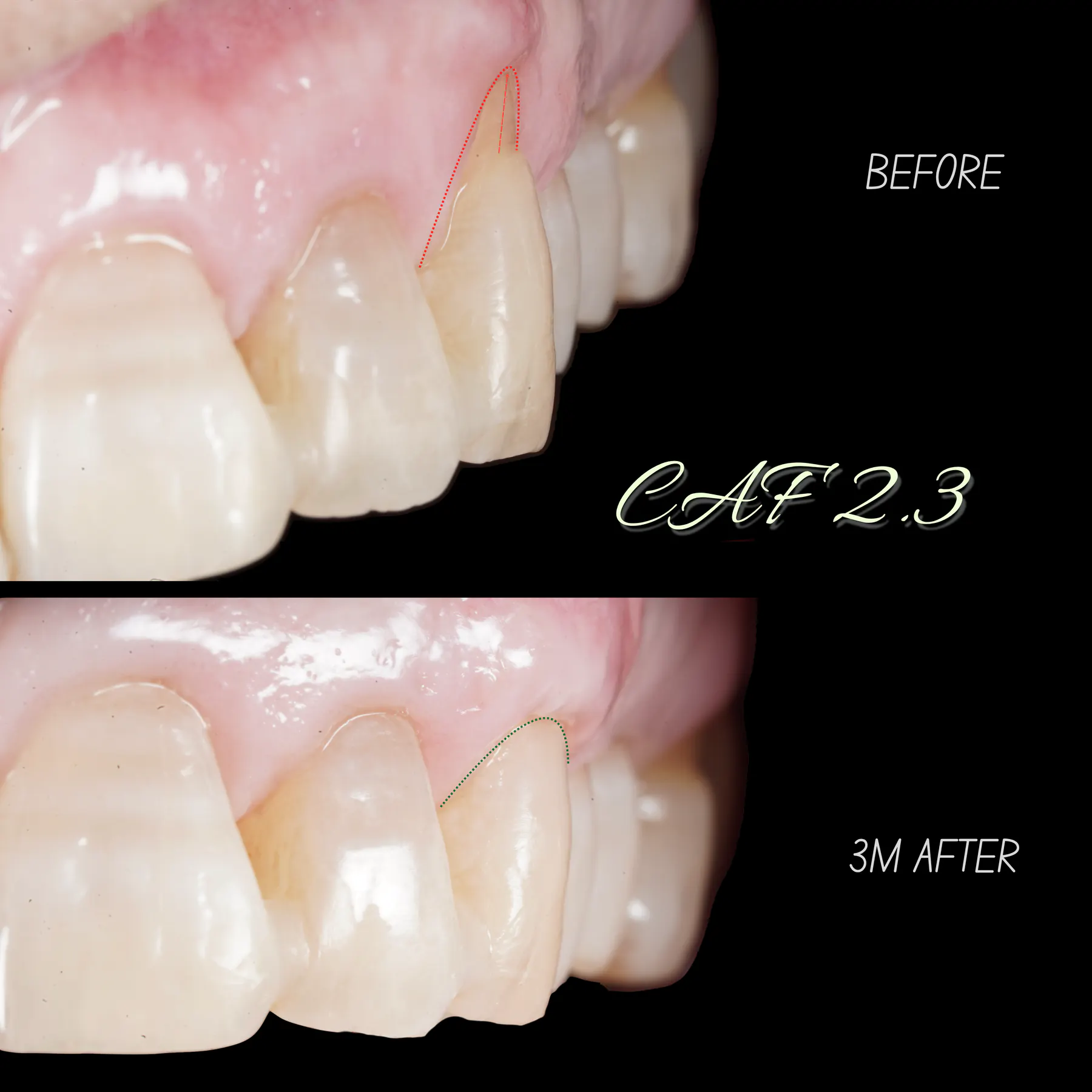
Before corrective treatment / 3 months after
The complete comparison shows the upper left canine before corrective surgery and at the confirmed three-month review. The original time labels and dotted contour markings remain visible.
View full-size image (opens in a new tab)The starting point
Recession persisted around the upper left canine after previous surgery. The case history describes thin gum tissue, mild sensitivity and concern about the appearance of the exposed root.
Previous surgical history, tissue mobility, recession anatomy, tooth position and plaque control were assessed before deciding whether revision was appropriate.
Understanding corrective root coverage
After previous gum surgery, a new plan starts with the tissue that is present now. In this case, moving the gum towards the tooth’s crown and adding a tissue graft were combined to improve root coverage.
Gum recession persisted around this upper left canine after earlier surgery. The thin tissue, mild sensitivity and appearance of the exposed root were reassessed before planning further treatment.
Why this matters
Previous treatment records, tissue mobility, support around the tooth and plaque control help guide the options. This case does not establish why the earlier procedure left recession.
The gum was moved towards the crown using a coronally advanced flap. A connective tissue graft from the palate—the roof of the mouth—was placed beneath it during the same operation.
Why this matters
Repositioning changes where the gum margin sits. The graft adds soft tissue to help improve thickness and contour. These are complementary parts of the root-coverage plan.
The graft and repositioned gum need protected healing and a blood supply. Reviews check the tissue and gum margin over time, together with symptoms such as sensitivity.
Why this matters
The clinical record reports complete root coverage and resolved sensitivity at three months in this patient. The drawing explains the aim; the actual photograph documents the appearance at that review.
Educational front views, not to scale or reconstructions of this patient’s anatomy. The graft is shown through the gum to explain its position. Arrows indicate movement towards the crown; the dashed line is an illustrative earlier margin. Incisions, sutures, donor-site details and bone are omitted. Root coverage does not by itself demonstrate bone regeneration or guarantee lasting coverage.
Two parts of the same plan
The flap is the patient’s existing gum, moved towards the crown. The graft adds a layer of connective tissue beneath it. The starting anatomy and condition of the tissue affect how much coverage can be achieved, especially when an area has already been treated.
Early reviews took place at two weeks and one month. The original photograph shows the three-month appearance, with its contour markings preserved. Complete coverage and resolved sensitivity are recorded clinical findings; the photograph alone cannot measure thickness or symptoms, or establish long-term stability.
Follow this patient’s treatment stagesTreatment sequence
Each stage has a different purpose. The sequence below places the photographs in the wider course of assessment, treatment and follow-up.
Before corrective treatment
The case history describes thin gum tissue and recession around the upper left canine after a previous recession procedure. Mild sensitivity and concern about appearance were the reasons for seeking further care.
Corrective surgery
A coronally advanced flap was used to move the gum towards the crown of the tooth and cover the exposed root. A connective tissue graft taken from the palate was combined with this approach in the same operation, with the aim of adding tissue thickness and improving root coverage.
2 weeks and 1 month
The original history records reviews at two weeks and one month, with progressive healing. These early checks form part of the follow-up sequence and are separate from the three-month photograph shown on this page.
3-month review
At the three-month review, the case records complete root coverage, improved tissue contour and resolution of sensitivity. The treating team has confirmed this follow-up timing, which matches the original photograph label.
Reading the follow-up
The three-month view shows a changed gum margin over the canine root compared with the starting photograph. The red and green dotted outlines are original annotations that help locate the contours being compared.
The photograph does not measure tissue thickness or sensitivity, and it cannot establish how the result will change over future years. Complete coverage and resolution of sensitivity are findings described in the clinical history, with follow-up timing confirmed by the treating team.
This case illustrates a course of corrective care after previous treatment. Its result does not establish what another revision procedure can achieve; that discussion starts with the current tissue condition and earlier treatment history.
Your questions
The gum was moved towards the crown of the tooth using a coronally advanced flap, combined with a connective tissue graft from the palate. Both were part of the same corrective operation described in the case history.
No. The available history records persistent recession after previous surgery but does not establish the reason for that result. This page describes the starting condition for corrective care without assigning a cause to the earlier outcome.
Three months after corrective surgery, as confirmed by the treating team and shown in the original image label. It documents that review point rather than a long-term result.
Yes. Tell the team what was treated, when surgery took place and what concerns you now. Mention any previous treatment records or photographs you have, so the team can advise which information would be useful for an assessment.
Explore your options
Explore assessment, treatment options and follow-up for recession.
Read about grafting and the role of gum thickness and contour.
Discuss your concerns and options after an earlier procedure.
Tell us what concerns you. In the enquiry form, choose “Gum recession / root coverage” as your main concern. The team can explain the next step and which existing records may be useful.
Appointments take place at collaborating dental clinics in Barcelona. The clinical location is confirmed when your visit is arranged. For visits from abroad, agree the assessment arrangements before booking travel.
Individual results vary. Revision recession surgery may be less predictable because of previous treatment, tissue quality, tooth position and healing response.