Skip to content
OsteoPerio
Mucogingival learning areas

OsteoPerio Academy / Advanced access concepts

Tunneled coronally advanced flap.
Plan each site. Connect the design.

TCAF combines selective CAF-like access with papilla-preserving tunnel regions. Study the tissue decisions, a published clinical sequence and the evidence behind the concept.

Explore the planning map

For qualified dentists · Professional teaching draft · Clinical review pending. The published photographs are not OsteoPerio cases. Use the original technique reports alongside supervised practical teaching.

01 / Two contributions / One connected plan

Preservation and access serve different needs.

The review describes a flexible approach, rather than a predetermined hybrid outline. Preserve vulnerable interproximal tissue where appropriate; create selective access where the anatomy supports it and where access helps mobilization or graft placement. The design is justified site by site.[13]

Tunnel contribution

Retain papillary continuity.

The surface of a selected papilla remains unincised while connected access is developed beneath the tissues. Preservation is particularly relevant when interproximal support or tissue volume is limited.[13]

Study tunnel principles
CAF contribution

Create selective working access.

An appropriate CAF-like region can improve access to connected tunneled areas, graft placement and flap mobilization. Papilla form, attachment and aesthetic location remain part of that choice.[13]

Review CAF design

Connect the reasoning: tissue assessment → selective preservation or access → recipient mobility and graft plan → stabilization → follow-up. This is a discussion map, not an automated treatment recommendation.

02 / Assessment before the incision

Describe the papilla, not only the recession.

Interproximal support

Record attachment and papilla fill at each site. A deficient papilla or visible embrasure changes the preservation objective; a buccal recession measurement alone does not describe this tissue.[13]

Papilla form and tissue quality

Inspect width, height, delicacy and the surrounding phenotype. The review favours preserving narrow or compromised papillae. A broader, well-supported papilla may provide an opportunity for selective access.[13]

Recession, mobility and location

Connect recession severity with available tissue movement and the aesthetic region. Access can facilitate mobilization, but the design should answer a local need rather than repeat the same incision at every tooth.[13]

Build the complete assessment record

03 / Read the published case

TCAF with selective connective-tissue grafting.

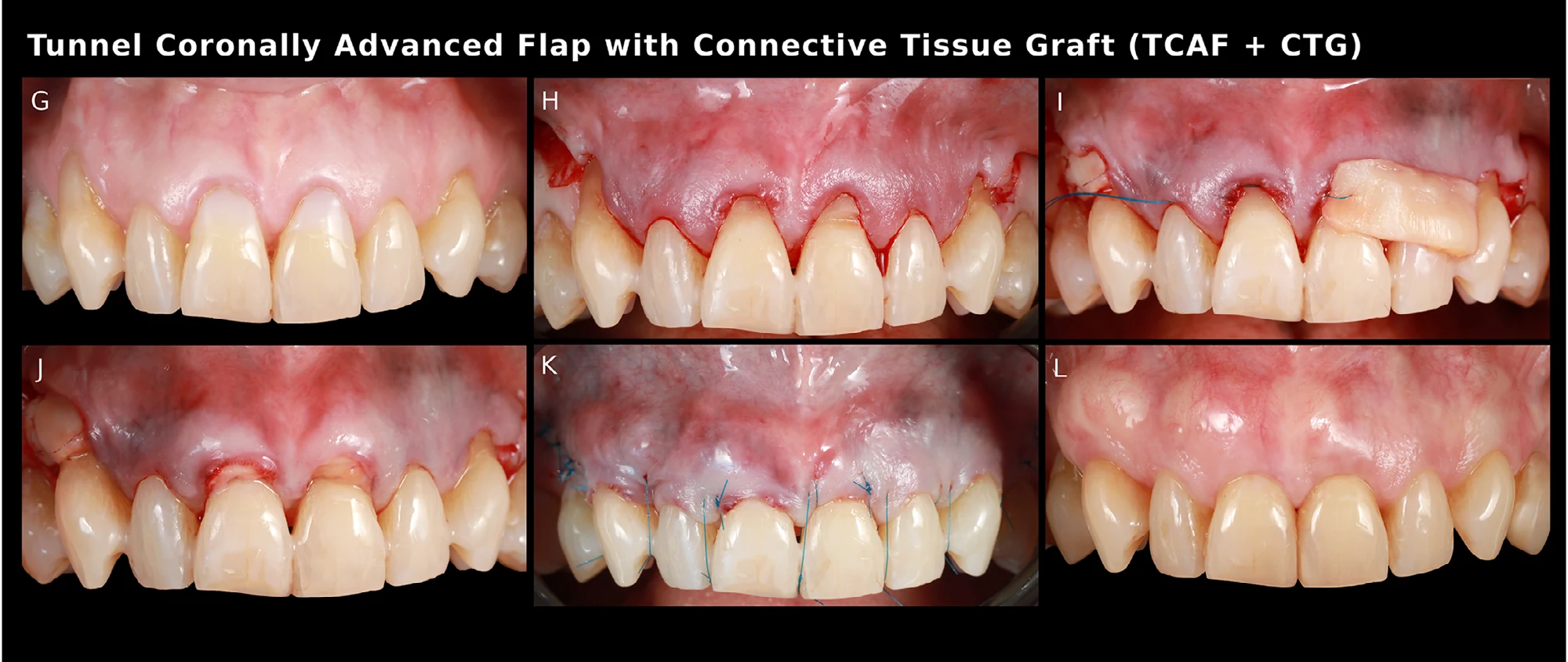
This crop isolates the TCAF example from Figure 5 of Tavelli and colleagues’ review. It shows multiple maxillary recessions. The caption specifies CTG at the canine and central incisors only, and a four-year outcome in panel L. The other techniques on the complete plate are separate cases.[13]

Published Figure 5G–L: six clinical photographs of TCAF for multiple maxillary recessions, with selective CTG at canine and central incisors and a four-year outcome in panel L.

Published clinical example / Figure 5, panels G–L

Figure 5G–L © 2026 Tavelli et al. Source article · CC BY 4.0. Cropped from the complete plate and converted to WebP; panel labels retained.

This is one documented case, not a comparative trial or an individual outcome promise. View the complete plate and source discussion.

  1. Panels G–I

    Map the treatment field

    Compare the initial tissues with the access and graft views. Identify which regions are visible and which remain connected beneath preserved tissue.

  2. Panels J–K

    Read coverage and support

    Examine adaptation and stabilization. Do not infer a complete suture pathway or an unshown operative manoeuvre from one photograph.

  3. Panels L

    Separate healing from immediate closure

    The published caption identifies this as a four-year outcome. Keep that follow-up attached to this case, rather than to every use of TCAF.

04 / Treatment checkpoints

Explain what each part of the plan must achieve.

Use these checkpoints to discuss the review’s design and tissue relationships. They are not a complete operative protocol or a substitute for the original method, clinical examination and practical training.

Define which tissue remains continuous

Mark the papillae intended for preservation and those selected for CAF-like access. TCAF can have no vertical release, one or two, according to the case. Record why any release is needed, particularly in an aesthetic region.[13]

Connect access with a mobile envelope

The review describes combined split- and full-thickness preparation. Open regions provide access to the connected tunneled portions. The teaching question is whether the planned envelope can move as intended while respecting the tissue that should remain intact.[13]

Plan the graft by recipient need

Identify the material, recipient extent and coverage objective. The published Figure 5 case places CTG selectively, at the canine and central incisors. Neither that distribution nor a uniform graft beneath every tooth is a rule for another patient.[13]

Separate graft fixation from flap support

A graft needs adaptation and stability; the overlying flap also needs support in its intended coronal position. CAF-like and tunneled areas can require different stabilization arrangements within the same treatment field.[13]

Check position without forcing the margin

Assess mobility and adaptation before relying on sutures to hold the flap. Papillary preservation, access, graft volume and coronal stabilization are connected decisions. An attractive immediate photograph cannot establish the stability of the healed result.[13]

Document the course of healing

Keep baseline, operative and follow-up records separate. Compare recession, tissue appearance and the patient’s experience over time. The four-year image in this published example belongs to that case and does not predict another patient’s outcome.[13]

05 / Evidence in context

Separate the concept, the material and the study.

2022 / CTG report

Isolated RT2 recessions with deficient papillae

Barootchi and Tavelli reported ten patients treated with TCAF and CTG, with assessment at six months. This early clinical report addresses a particular interproximal limitation. Its small, non-comparative sample cannot establish superiority over CAF or tunnel treatment, or a reliable probability for an individual case.[24]

Keep the defect, graft and follow-up attached to the finding.

2022 / Matrix case series

Multiple adjacent recessions with a collagen matrix

Tavelli and Barootchi described five patients and sixteen recessions treated with a volume-stable xenogeneic collagen matrix, assessed at six months. This is a different material and clinical population from the CTG report. It does not prove that a substitute is equivalent to an autogenous graft.[25]

Do not pool different materials and indications into one success claim.

2026 / Technical framework

A proposed papilla-based decision tree

The later technical paper develops the rationale and a decision tree. Its proposed 30° papilla angle and 4 mm recession-depth guideposts are preliminary, not validated treatment cutoffs. The framework has not been prospectively validated in a controlled trial.[26]

Use it for critical discussion, not an automatic incision calculator.

The review provides a historical and biological context. Neither its case illustrations nor the early reports establish that TCAF should replace established CAF or tunnel options. Ask which patients, comparator, material, endpoints and follow-up support each claim.[13][24][25]

06 / Case discussion

Present a reasoned design before naming the technique.

Teaching scenario / No patient data

Adjacent recessions. Different papillae.

Imagine a maxillary segment with a delicate, deficient papilla next to a broader, better-supported one. Recession depth and available tissue movement also differ. Before proposing TCAF, explain:

  1. Which examination findings and patient goals are still missing?
  2. Which tissue would you aim to preserve, and where might access help?
  3. What graft, coverage and stabilization questions remain unresolved?
  4. Which alternative would you discuss, and how would you review healing?

There is no automatic correct incision from this brief. The objective is a defensible assessment and discussion, not remote case selection.

Is TCAF simply a tunnel with an extra incision?

The review presents it as a site-specific integration of CAF and tunnel principles. The useful explanation identifies which papillae remain intact, where access is created and how those choices support the proposed tissue movement. Naming the technique is only the start of the plan.[13]

Does preserving more papillae prove a better clinical outcome?

Preservation has a biological and aesthetic rationale, but a rationale is not a comparative result. A published case or narrative review cannot show that TCAF is better for every recession. The original early reports also differ in defect type and graft material.[13][24][25]

Should the tunnel or open component be prepared first?

The 2026 technical paper describes tunnel preparation first, followed by the CAF component and any vertical releases. It explicitly treats this order as a practical preference; it does not establish that the reverse sequence is inferior.[26]

07 / Scientific reading

Return to the source and its limits.

Short descriptive titles identify each source. Open the linked record for the full article title and bibliographic details.

  1. [13] Contemporary narrative review / 2026

    Tracing the evolution of root coverage: Clinical milestones leading to a minimally invasive era

    Tavelli L, Yilmaz B, Steiner Back L, et al. Journal of Periodontology. 97(5):983–1009. doi:10.1002/jper.70044.

    Historical and conceptual development of flap designs, grafting and stabilization; the review does not rank techniques by the strength of comparative evidence.

  2. [24] Preliminary clinical report / 2022

    TCAF for isolated RT2 recessions with deficient papillae

    Barootchi S, Tavelli L. International Journal of Esthetic Dentistry. 17(1):14–26.

    Ten patients treated with CTG and followed for six months; no comparative group. Findings do not establish superiority or an individual outcome probability.

  3. [25] Clinical case series / 2022

    TCAF with a volume-stable collagen matrix for multiple recessions

    Tavelli L, Barootchi S. International Journal of Periodontics & Restorative Dentistry. 42(2):155–162. doi:10.11607/prd.5747.

    Five patients and sixteen recessions, assessed at six months. A matrix-based series does not establish equivalence to CTG.

  4. [26] Technical and conceptual report / 2026

    TCAF for root coverage: rationale, indications and a novel papilla-based decision tree

    Tavelli L, Barootchi S. Journal of Periodontal Research. 61(8):981–996. doi:10.1111/jre.70147.

    Proposes a site-specific framework using preliminary clinical data. The decision tree requires prospective validation; its numerical guideposts are not established treatment thresholds.