The clinical concern
The available bone height at the back of the upper jaw was limited beneath the maxillary sinus. The site needed augmentation as part of planning for an implant-supported tooth.
Clinical case · Implant Surgery
Limited bone height in the back of the upper jaw called for sinus augmentation. In this case, a lateral sinus lift and implant placement were carried out during the same operation, with healing and restorative care as separate stages.
Surgery performed by Dr. Sahand Shirzadi Maryan and Dr. Sergi Rivas Frau.
One patient’s treatment sequence. Suitability and healing vary; your own options require an assessment.
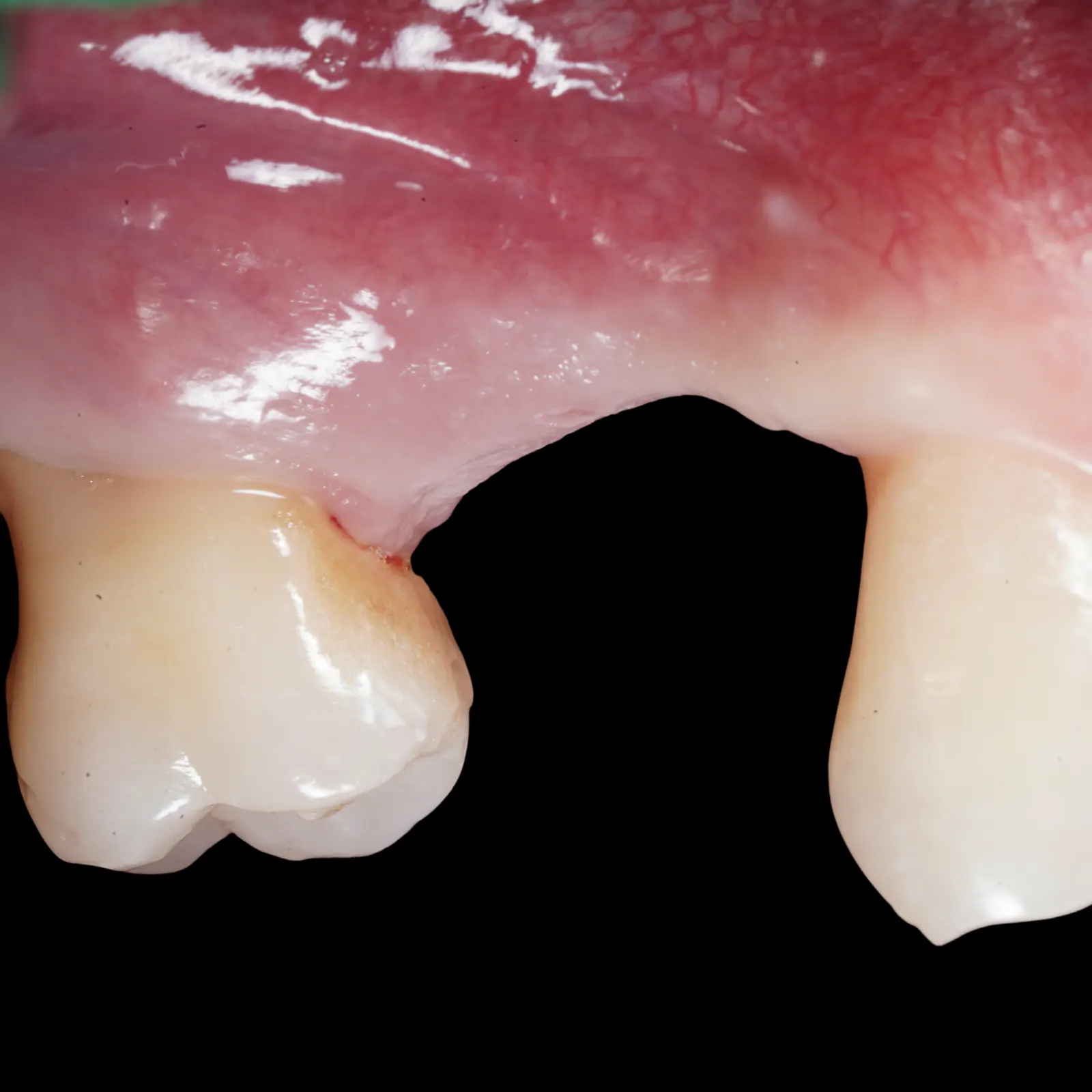
Clinical view · upper posterior tooth space
This photograph shows the surface tissue at the tooth space. The grafted area beneath the sinus and the implant are not directly visible in this view.
View full-size image (opens in a new tab)The starting point
The available bone height at the back of the upper jaw was limited beneath the maxillary sinus. The site needed augmentation as part of planning for an implant-supported tooth.
CBCT assessment considered the remaining bone height, sinus anatomy and surgical access. The planned implant position also took account of the future restoration.
Why lift the sinus lining?
The implant needs a suitable foundation beneath the sinus. These drawings explain the anatomy and how augmentation and implant placement can fit into one operation, as they did in this case.
The sinus is an air-filled space above the upper back teeth. At a missing-tooth site, the remaining bone may be too shallow for the proposed implant plan.
Why this matters
The scan helps us assess bone height and width, the sinus and the position of the future tooth. A sinus lift is one option; the alternatives depend on the individual anatomy.
In this case, access through the side of the upper jaw allowed the thin sinus lining to be gently raised. Graft material was placed in the space beneath it.
Why this matters
The graft supports bone development below the raised lining. It does not fill the whole sinus, and freshly placed graft material is not yet mature bone.
Here, the implant was placed during the sinus augmentation. Its initial stability depends on the available bone; the surrounding grafted area still needs to heal.
Why this matters
If stable placement is not possible, grafting and implant placement may need separate operations. The dashed tooth below is a future restoration reference, not a tooth fitted during this surgery.
Educational cross-sections, not to scale or a reconstruction of this patient’s scan. The dashed horizontal line marks the original sinus floor. Surgical access, closure details, neighbouring teeth and sinus drainage are omitted. The diagrams do not establish implant dimensions, bone gain or a healed result; grafting and placement are shown conceptually, not as an operative guide.
One surgical phase. Further stages of care.
01
The gum and surgical area need care and review. Your team gives instructions specific to the operation and checks for concerns during recovery.
02
Bone develops in the grafted area while the implant integrates with bone. Clinical reviews and appropriate imaging guide the assessment; a surface photograph cannot confirm this.
03
The restoration is a separate stage, planned when the implant and tissues are ready. This case photograph does not show a definitive crown or establish its timing.
The original clinical photograph above shows the gum-covered tooth space. These diagrams explain what a surface photograph cannot show; they are separate from the patient’s clinical evidence.
Treatment sequence
Each stage has a different purpose. The sequence below places the photographs in the wider course of assessment, treatment and follow-up.
Assessment
CBCT imaging helped assess the available bone height, sinus anatomy and access for surgery. Implant planning also considered the position of the future tooth restoration.
Sinus access
A lateral approach through the side of the upper jaw was used to access and gently lift the sinus membrane. Piezosurgery was used during the preparation, creating access for augmentation beneath the membrane.
The same operation
Bone augmentation and implant placement were completed during the same surgical phase. This approach depends on being able to obtain sufficient initial implant stability in the available bone; it is not suitable for every sinus lift case.
After surgery
Clinical and radiographic follow-up assess the tissue, augmented site and implant before decisions about the restoration. Placing an implant during sinus augmentation does not mean fitting the final crown during that operation.
Reading the follow-up
The clinical photograph shows the gum tissue at the upper posterior tooth space. It provides a surface view of the area described in this case.
A surface photograph cannot establish the amount of regenerated bone, the condition of the sinus membrane or whether the implant has integrated. Those questions require the clinical findings and appropriate imaging.
The timing of the definitive crown depends on the assessment of healing and implant readiness. The photograph on this page does not show a final crown or establish a long-term result.
Your questions
No. Here, one surgical phase refers to sinus augmentation and implant placement. The definitive crown is a separate restorative stage, arranged after the implant and surrounding tissues have been assessed.
No. The amount and quality of the remaining bone, the ability to stabilise the implant, sinus anatomy and surgical findings affect that decision. Some patients need augmentation first and implant placement after healing.
It helped assess the three-dimensional relationship between the remaining bone, sinus and proposed implant position. Using CBCT for planning does not by itself mean that a surgical guide was used.
It shows the surface tissue only. Graft maturation and implant integration need clinical assessment and, when appropriate, imaging. A similar appearance in another patient does not establish the same healing stage or readiness for a crown.
Explore your options
Explore the approaches, selection factors and stages of care.
Read about building an implant site and why staged care may be needed.
Clarify a proposed sinus lift or implant treatment plan.
Tell us what concerns you. In the enquiry form, choose “Sinus lift / posterior maxilla” as your main concern. The team can explain the next step and which existing records may be useful.
Appointments take place at collaborating dental clinics in Barcelona. The clinical location is confirmed when your visit is arranged. For visits from abroad, agree the assessment arrangements before booking travel.
Individual results vary. Simultaneous implant placement depends on residual bone, primary stability, sinus anatomy and medical factors.