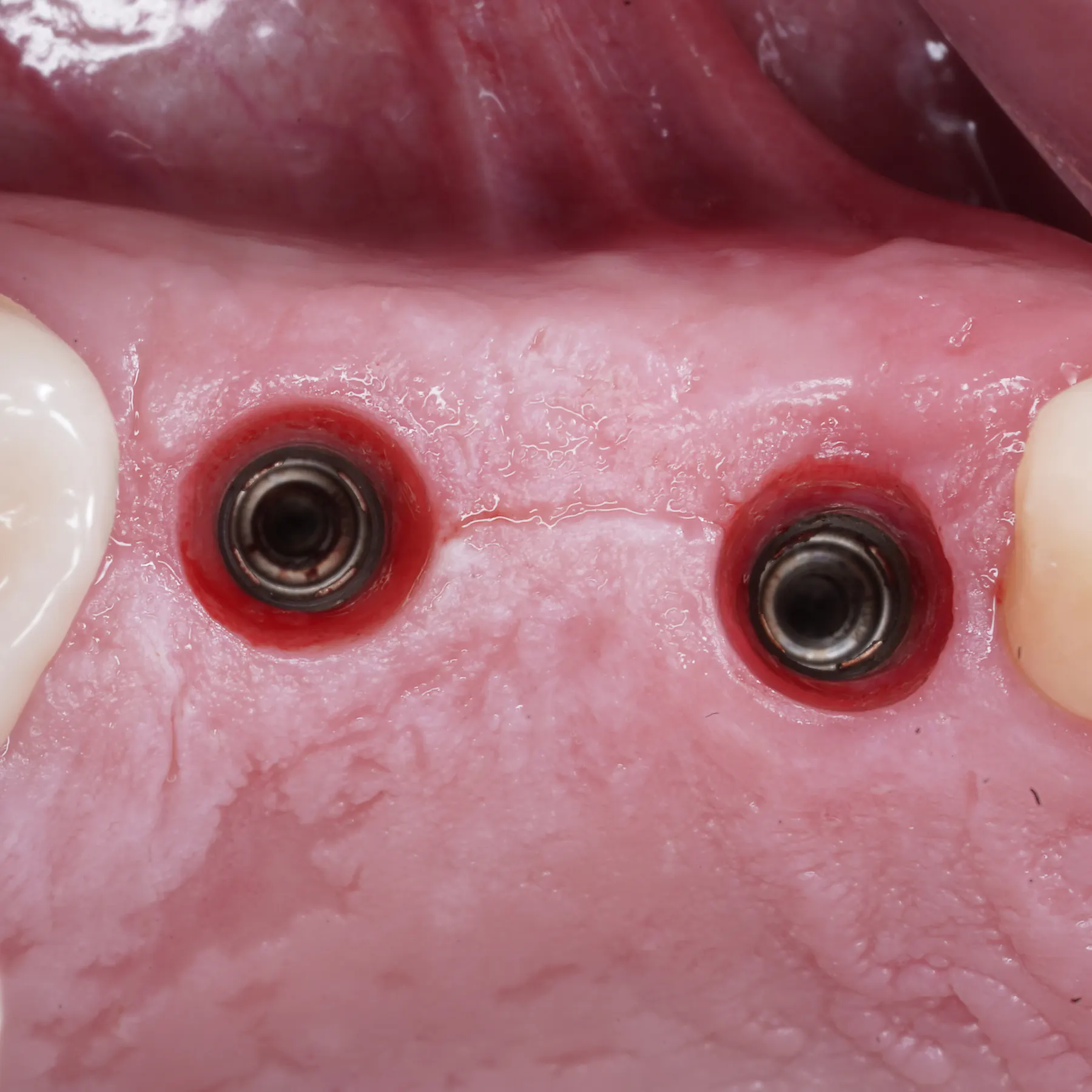
This case involved tooth extraction and immediate implant placement. The clinical photograph offers a close-up view of the gum around the implant connections. Explore the confirmed treatment sequence and why the surrounding tissue matters when planning implant care.
Surgery performed by Dr. Sahand Shirzadi Maryan and Dr. Sergi Rivas Frau.
One patient’s treatment sequence. Suitability and healing vary; your own options require an assessment.
A closer view of the peri-implant tissue
Two implant connections and the surrounding gum are visible with no crowns in place. This single view records the surface appearance; it is not a before-and-after comparison or a dated long-term review.
The case involved tooth extraction and immediate implant placement. The available photograph focuses on the surrounding gum tissue, a part of the implant site that is considered alongside the supporting bone and future tooth restoration.
What informed the plan
Immediate implant planning considers the extraction site, remaining bone, gum tissue and the intended restoration. The treating team confirmed the extraction-and-placement sequence; the photograph provides a tissue view rather than a record of the surgical planning.
Understanding immediate implant placement
Placement is one step. The surrounding tissue matters too.
The confirmed sequence is extraction followed by implant placement at the same visit. These illustrations explain what that means and why assessment continues as the tissues heal and the tooth restoration is planned.
BoneGumImplant / connectorOutlined planned tooth
01 / Tooth extraction
Assess the site left by the tooth.
The tooth was removed as part of the implant plan. The space left in the jaw is called the socket. Its shape, remaining bone and surrounding gum are important to the next decision.
Why this matters
Immediate placement requires assessment of the site and the ability to stabilise an implant in an appropriate position. It is not suitable for every extraction.
02 / The same appointment
Place the implant in the extraction site.
In this case, implant placement followed extraction at the same appointment. The implant needs support from the remaining bone; it does not simply replace the tooth with an identical shape.
Why this matters
“Immediate” describes placement timing. The tissues still need healing and review. It does not by itself mean that a temporary tooth or final crown was fitted that day.
03 / Healing and restorative planning
Consider the gum and future tooth together.
Bone supports the implant, gum surrounds the connection, and the restoration provides the visible tooth. Reviews consider these parts together, including tissue health, contour and access for cleaning.
Why this matters
The outlined tooth represents a restoration being planned, not a confirmed crown in this case. Its timing and shape depend on the clinical assessment.
Educational cross-sections, not to scale or reconstructions of this patient’s anatomy. One implant explains the principle; the clinical photograph shows two connections. Socket shape, support, closure and restorative components are simplified. No bone or gum graft is depicted because a graft procedure has not been confirmed for this case. The last panel does not establish implant integration, tissue gain or crown delivery.
Reading the clinical photograph
Connections and gum are visible.
The photograph shows two implant connections with no crowns in place. The implant bodies and surrounding bone are beneath the surface. The picture helps show gum contour, but it cannot on its own establish bone health or implant stability.
A tissue view, without a dated milestone.
The team has confirmed extraction and immediate placement. Operative photographs are not available, and the timing of this close-up is not specified. It is therefore presented as a tissue view, separate from the educational treatment sequence.
“More gum” can mean different things. The assessment identifies which tissue feature needs attention and how it relates to the implant, the crown and everyday cleaning. These general principles explain the planning; they are not measurements from this photograph.
01Thickness
The volume of tissue.
This is the depth of the soft tissue around the implant. Adding volume is a different goal from widening the band of firmer gum.
02Firmer gum
The tissue beside the implant.
Called keratinized mucosa, this band can matter for brushing comfort. If it is deficient and cleaning is uncomfortable, augmentation may be considered after assessment.
03Contour
The shape around the crown.
The tissue margin, implant position and restoration shape are assessed together. A graft alone cannot reposition an implant or correct every restorative problem.
A core focus of OsteoPerio
Reconstruction planned around the whole site.
Complex bone and soft tissue reconstruction is central to our work. With an existing implant, that means considering the tissue, bone support and restoration together. Inflammation and bone loss need their own assessment; a soft tissue graft is not a substitute for treating peri-implant disease.
General background from the European Federation of Periodontology. These sources explain tissue assessment and care; they do not verify this individual case.
The treating team confirms extraction and immediate implant placement. The surgical stages are described below; the available photograph shows the surrounding tissue, without operative photographs or a confirmed review interval.
01
Extraction
Remove the tooth as part of the implant plan
The tooth was removed as part of the implant treatment. The next stage took place at the same appointment, rather than after a separate period of socket healing.
02
Immediate implant placement
Place the implant at the extraction appointment
Implant placement was performed immediately after extraction. “Immediate” describes when the implant was placed; it does not by itself mean that a temporary tooth or a final crown was fitted on the same day. No operative photographs are available for this case.
03
Clinical documentation
View the tissue around the implant connections
The available photograph shows two implant connections without crowns in place. It provides a close-up view of the gum contour. The date relative to surgery is not recorded here, so the image is presented without a healing milestone.
04
Continued review
Assess healing and everyday maintenance
In this type of care, reviews assess healing and the arrangements for the tooth restoration, followed by cleaning and maintenance. The photograph does not establish when this patient received the crowns or document a long-term review.
Understanding the photograph
A close-up view. One part of the clinical picture.
What the image shows
The image shows the visible gum contour around two implant connections without crowns. It allows the soft tissue at these sites to be seen directly.
What it cannot establish
There is no matched pretreatment view or confirmed interval on this photograph. It cannot measure tissue gain, establish the health of the underlying bone or demonstrate long-term implant stability.
Extraction and immediate implant placement are confirmed by the treating team. Operative photographs are not available. The date of this tissue photograph and any later restoration records can add further context to the case.
Your questions
Putting this case in context.
What does “peri-implant soft tissue” mean?
It means the gum and other soft tissues surrounding a dental implant. Tissue thickness, the band of firmer gum and the shape around the restoration are separate features assessed during planning.
Does every implant with thin gum tissue need surgery?
No. Thin tissue alone does not establish a need for a graft. The assessment considers discomfort, cleaning access, inflammation, changes over time and your priorities. Monitoring, hygiene care or changes to the restoration may be appropriate.
Is a gum graft a treatment for peri-implantitis?
Peri-implantitis involves inflammation and loss of supporting bone. A gum graft alone does not replace assessment and treatment of that disease. Tissue reconstruction may form one part of a broader treatment plan when indicated.
Does this photograph show a final result?
It shows one clinical view with no crowns in place. Its timing relative to surgery is not documented here, so it is not presented as a final restoration or proof of a lasting result.
Can the crown or implant position affect the plan?
Yes. A graft cannot move an implant, and the crown shape influences the tissue contour and cleaning access. Some concerns require restorative changes or a broader reconstruction plan as well as soft tissue care.
Can I request a review of an implant placed elsewhere?
Yes. Tell us what concerns you and which implant records, radiographs and previous treatment details are available. For visits from abroad, agree the assessment and follow-up arrangements before booking travel.
Discuss previous treatment, tissue changes or a proposed reconstruction.
Start with an assessment.
Tell us what concerns you. In the enquiry form, choose “Failed implant / peri-implant problem” as your main concern. The team can explain the next step and which existing records may be useful.
Appointments take place at collaborating dental clinics in Barcelona. The clinical location is confirmed when your visit is arranged. For visits from abroad, agree the assessment arrangements before booking travel.
Individual results vary. Peri-implant soft tissue outcomes depend on implant position, restoration design, tissue quality and maintenance.