The clinical concern
External root resorption had damaged an upper front tooth. There was insufficient space for the planned implant and replacement tooth, so the treatment needed orthodontic preparation before extraction.
Clinical case · Multi-disciplinary
External root resorption had damaged an upper front tooth. Orthodontic treatment first created space, followed by extraction, immediate implant placement and connective tissue grafting. A temporary tooth was used during healing before the final restoration.
Surgery performed by Dr. Sergi Rivas Frau.
One patient’s treatment sequence. Suitability and healing vary; your own options require an assessment.
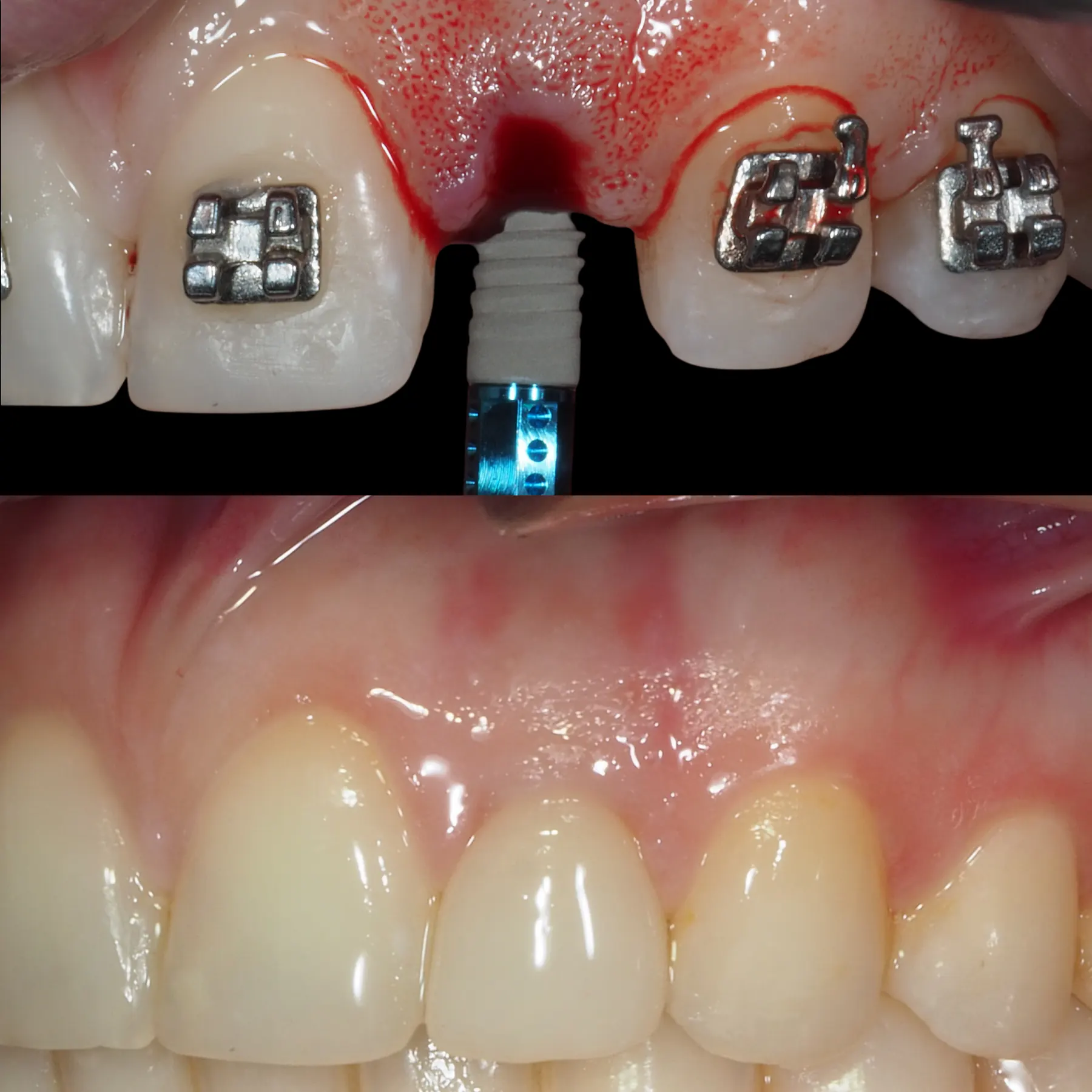
Implant placement / later restored appearance
The upper image shows the implant placement stage with orthodontic brackets still present. The lower image shows a later restored appearance. These are different treatment stages, not a same-day final-tooth comparison.
View full-size image (opens in a new tab)The starting point
External root resorption had damaged an upper front tooth. There was insufficient space for the planned implant and replacement tooth, so the treatment needed orthodontic preparation before extraction.
The plan coordinated the space between adjacent teeth, implant position, gum support and the shape of the replacement tooth. It also included a temporary tooth for the healing period before the final restoration.
Why plan before removing the tooth?
Replacing a front tooth involves its root, the available space, the visible tooth and the surrounding gum. This case brought orthodontic preparation, implant surgery and restorative care into one coordinated plan.
External root resorption is a loss of tooth structure that begins on the outside of the root. Its location and extent help determine whether the tooth can be treated and kept.
Why this matters
In this case, the plan was to replace the compromised upper left lateral incisor. Resorption does not automatically mean that every affected tooth needs extraction.
There was insufficient space for the planned implant and restoration. Orthodontic treatment prepared the space before the tooth was removed.
Why this matters
Planning considers the neighbouring roots as well as the visible gap. The implant position, replacement tooth and gum contour need to work together.
The tooth was removed and an implant was placed at the same appointment. A connective tissue graft was also used to support the surrounding gum tissue.
Why this matters
The implant replaces the root; the soft tissue graft supports gum thickness and contour. Immediate placement still requires suitable anatomy and implant stability, followed by healing.
The visible crown of the extracted tooth was adapted as a temporary replacement. The damaged root was not retained. A definitive restoration followed later.
Why this matters
A temporary tooth serves the healing phase. Its support and use are planned individually; immediate implant placement alone does not tell us whether a tooth is attached to or loaded on the implant that day.
Educational illustrations, not to scale or reconstructions of this patient’s anatomy. The root defect, tooth spacing, implant position and graft location are schematic. The third panel is a cutaway; the gold area represents gum grafting, not a bone graft. Socket details, closure and temporary-tooth attachment are simplified or omitted. No measured tissue gain or implant integration is shown.
The timing recorded for this patient
The case history records a two-week healing review and final restoration at about three months. Those timings describe this patient’s care. Readiness for restoration in another case depends on the implant, tissues and clinical assessment.
The upper image shows the implant-placement stage with orthodontic brackets. The lower image shows a later restored appearance. It has no date label, so it cannot on its own establish the exact follow-up interval or long-term stability.
Follow this patient’s treatment stagesTreatment sequence
Each stage has a different purpose. The sequence below places the photographs in the wider course of assessment, treatment and follow-up.
Before implant surgery
The compromised tooth was an upper left lateral incisor, identified as tooth 2.2 in the case history. Orthodontic treatment was used to create space for the planned implant and restoration before extraction.
Surgery
After the orthodontic preparation, the tooth was removed and an implant was placed in the extraction site during the same appointment. A connective tissue graft was also used to support the surrounding gum contour.
Temporary replacement
The visible crown of the extracted tooth was adapted as a temporary replacement during healing. This was an interim solution, separate from the definitive implant restoration.
2-week review
The case history records an early healing review at two weeks. This check was part of the healing phase; it was not the final assessment of tissue stability or implant performance.
About 3 months
The final restoration was delivered at approximately three months, according to the case history. That interval describes this case and is not a treatment timetable for other patients.
Reading the follow-up
The composite brings together a surgical view with orthodontic brackets and a later view of the restored tooth and surrounding gum. It illustrates separate steps in a coordinated course of care.
The images do not measure implant integration, bone levels or long-term stability. The lower photograph is not time-labelled, so its appearance alone cannot establish the exact follow-up interval.
The case history describes a two-week healing review and final restoration at about three months. Continued maintenance is needed after restoration; these early stages do not establish a long-term result.
Your questions
There was insufficient space for the planned implant and restoration. Orthodontic preparation addressed that limitation before the tooth was removed. Not every implant case needs orthodontics; the need depends on the available space and treatment goals.
No. Immediate placement means the implant was placed at the extraction appointment. This case used a temporary tooth during healing, followed by the final restoration at a later stage.
The crown portion was adapted as a temporary replacement after extraction. That does not mean the damaged root was retained or that the final implant crown was fitted immediately. The choice and support of a temporary tooth depend on the individual plan.
No. The location and extent of resorption, the remaining tooth structure and the available treatment options need assessment. This case describes a decision to replace one compromised tooth, rather than a rule for all teeth with resorption.
Explore your options
Understand selection, extraction-day placement and the separate restorative stage.
Explore the role of tissue thickness and contour around teeth and implants.
Discuss a proposed extraction or implant plan before deciding on treatment.
Tell us what concerns you. In the enquiry form, choose “Advanced implant placement” as your main concern. The team can explain the next step and which existing records may be useful.
Appointments take place at collaborating dental clinics in Barcelona. The clinical location is confirmed when your visit is arranged. For visits from abroad, agree the assessment arrangements before booking travel.
Individual results vary. Aesthetic implant outcomes depend on bone volume, soft tissue phenotype, tooth position, restoration design and healing response.